

Joint Genesis Review (Evidence-Based): Synovial Fluid, Hyaluronan (HA), and What’s Realistic After 40
Article 2 of 2
If you landed here from search: you’re not late, and you’re not missing context.
This page starts from fundamentals and builds toward a practical decision.
If you wish to→ read Article 1
Mobility doesn’t collapse overnight. For most people, it starts as small signals: morning stiffness, creaky knees on stairs, tight hips after sitting, a shoulder that doesn’t “glide” like before.
And in many cases, the conversation eventually turns to the joint environment — especially synovial fluid and the molecules that influence how “smooth” movement feels, including hyaluronan (HA).
This page is built to answer three questions:
- What does joint lubrication actually mean in real biology?
- What does HA have to do with the synovial environment?
- Where does Joint Genesis fit as an option — without hype, without miracle language?

🛡️ Quick medical note
This is educational content only. It’s not medical advice. Joint pain has many causes. If you have swelling, fever, trauma, sudden weakness/numbness, or persistent symptoms, seek evaluation.
🟩 Part 1 — why joints feel different after 40
1) Mobility is not just “flexibility”
Mobility is a system: strength + control + coordination + endurance + pain modulation + tissue health.
People often blame stiffness on “tight muscles,” but the bigger pattern is usually multi-factor.
A simple truth: when your movement system becomes less supported (less strength, less daily motion, worse sleep, more stress), the body tends to protect itself. That protection can show up as stiffness and pain sensitivity.
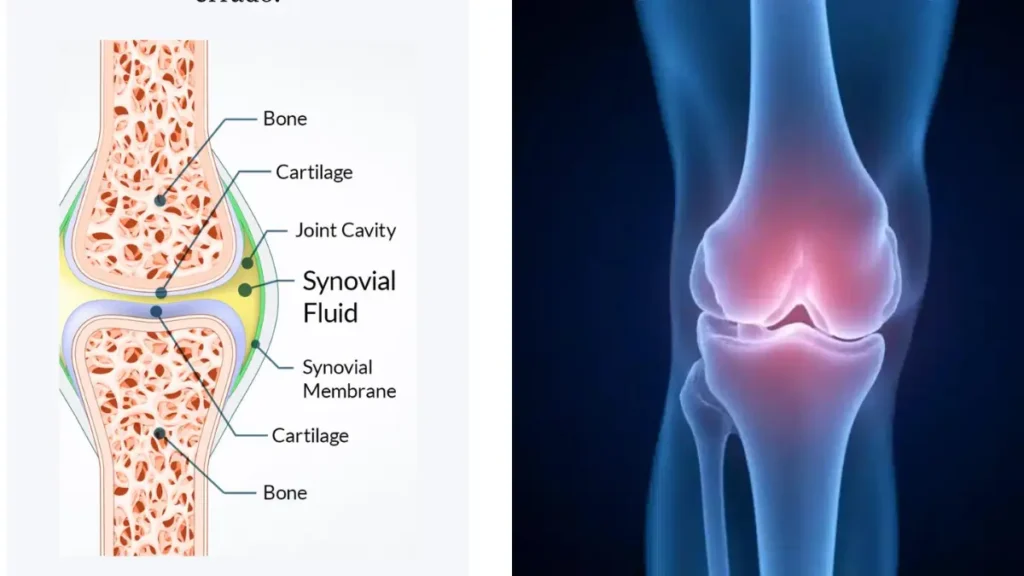
2) Synovial joints run on an internal environment
Knees, hips, and shoulders are synovial joints. Inside them is synovial fluid, a viscous fluid that helps:
- reduce friction between surfaces
- absorb shock
- nourish cartilage
- carry away waste products
This is not marketing — it’s basic anatomy and physiology.
3) Where hyaluronan (HA) matters
Hyaluronan (often called hyaluronic acid / HA) is a major component contributing to the viscosity and elastic behavior of synovial fluid. Research has long described HA’s distribution and functional role in tissues and joint environments (Fraser et al., 1997).
You’ll often hear people say “my joints feel dry.” That’s not a technical diagnosis — but it points to a real concept: the “quality” of the joint environment can affect how movement feels.
4) Pain can be protective, not just “damage”
Pain is complex. Two people can have similar imaging and very different pain and function. Chronic pain can amplify sensitivity and create a loop:
stiffness → less movement → less capacity → more sensitivity → more stiffness
This is why the best long-term approach is usually a blend of:
- consistent movement exposure
- strength support
- recovery (sleep, stress)
- and smart decision-making about add-ons
5) What “evidence-based” actually means here
Evidence-based doesn’t mean “guaranteed.” It means:
- the mechanism is biologically plausible
- the claims are measured and realistic
- the company avoids extreme promises
- you can find clear ingredient disclosure and safety context
So the right question is not “does this cure joint pain?”
The right question is: Is this a reasonable supportive option for some people, alongside lifestyle basics?
🟩 Part 2 — what to do first, then how to evaluate Joint Genesis
Step 1: Do the basics for 7–14 days (yes, even if you’re busy)
If you do nothing else, do this:
Daily (10 minutes):
- 3 minutes: easy walking or cycling (warm-up)
- 4 minutes: sit-to-stand + calf raises + gentle hip hinge practice
- 2 minutes: shoulder wall slides
- 1 minute: slow breathing (long exhale)
This is not a “fitness plan.” It’s a nervous-system signal: movement is safe.
Step 2: Use a simple decision checklist
Before you spend money on anything, check:
- Consistency: Am I moving most days of the week?
- Strength: Do I have basic leg and hip strength support?
- Recovery: Is sleep sabotaging pain sensitivity?
- Expectations: Am I looking for support — or a miracle?
If you fix zero basics, supplements become an emotional purchase.
If you fix a few basics, supplements become a rational add-on.
🟩 Where Joint Genesis fits (without magical thinking)
Joint Genesis is typically positioned around joint comfort and the synovial environment, often tying into concepts like joint lubrication and HA-related biology.

A reasonable framing is:
- not a cure
- not a replacement for movement and strength
- a supportive option some people explore when stiffness becomes persistent
How to evaluate it like a grown-up
Look for:
- Clear ingredient disclosure
- Safety notes (who should avoid it)
- No disease-treatment language
- Realistic expectations (support, comfort, mobility routine synergy)
If the page screams “reverse arthritis fast,” close it.
If it reads like a measured product explanation, keep reading.
If you want to review Joint Genesis in a straightforward way (ingredients, positioning, and who it may be for), go to the official page here:
→ Genesis Official Website
(Editorial note: if you purchase through our link, we may earn a commission at no extra cost to you.)
Want the full science-first mobility foundation (aging, pain cycles, lifestyle, evidence-based strategies)?
Read the complete guide here: → Mobility Pillar Article
🟩 FAQ (para orgânico: resolve dúvidas sem pressa)
Is synovial fluid “real” or just a marketing buzzword?
It’s real anatomy. Synovial fluid exists in synovial joints and supports lubrication and nutrient transport.
What is HA in plain terms?
A large molecule that helps give synovial fluid its viscosity and elastic behavior.
Does this mean HA supplements will “fix” joints?
Not necessarily. Biology is not a guarantee. Supportive options can be part of a broader plan, not a replacement for fundamentals.
When should I see a professional?
If you have swelling, fever, trauma, inability to bear weight, neurological symptoms, or symptoms persisting beyond a few weeks despite self-care.
🛡️ Medical Disclaimer
This content is for educational purposes only and does not provide medical advice, diagnosis, or treatment. Always consult a qualified healthcare professional for medical concerns.
🟩 Editorial Transparency
This is educational editorial content. Some links may be affiliate links. If you purchase through them, we may earn a commission at no extra cost to you. Our editorial content is created independently.
🟩 Selected References (reais, sem inventar)
- Fraser JR, Laurent TC, Laurent UB. Hyaluronan: its nature, distribution, functions and turnover. Journal of Internal Medicine. 1997;242(1):27–33.
- Jay GD, Waller KA. The biology of lubricin: near-frictionless joint motion. Matrix Biology. 2014;39:17–24.
- World Health Organization. Guidelines on physical activity and sedentary behaviour. 2020.
- American College of Sports Medicine. ACSM’s Guidelines for Exercise Testing and Prescription. (11th ed., 2021)
