

Joint Stiffness After 40: Synovial Fluid, Hyaluronan (HA), and a Practical 10-Minute Mobility Strategy
Article 1 of 2 — Start here
(For the science-first deep dive, read Article 2: → Complete Guide to Mobility: Movement, Pain, Aging, and Evidence-Based Strategies.)
As we get older, many people describe the same pattern:
You stand up after sitting… and your joints feel “rusty.”
You move a bit… and it loosens.
But the next morning, it’s back.
This isn’t just “getting old” in a vague way. It often reflects changes in how joints handle load, movement, and lubrication — especially inside synovial joints (knees, hips, shoulders).
This article is designed to do two things:
- explain, in plain English, what synovial fluid and hyaluronan (HA) have to do with joint comfort and movement
- give you a simple, realistic strategy you can try this week (no heroics)
If you want the full scientific foundation (biology, aging, pain cycles, lifestyle, and evidence-based strategies), go to → Article 2.

🛡️Quick note before we start
This is educational content. It does not diagnose, treat, or cure anything. Joint pain has many causes, and persistent or worsening symptoms deserve professional evaluation.
🟩 Why joints can feel “stiffer” after 40 (without any dramatic injury)
A lot of joint discomfort isn’t a single event — it’s a system problem:
- less daily movement “pumping” the joint
- less strength supporting the joint under load
- more sensitivity to discomfort (pain becomes protective)
- changes inside the joint environment that affect “smooth motion”
For many people, the early warning sign is not extreme pain. It’s friction:
stairs feel harder, knees feel cranky, hips feel tight, shoulders feel stiff.
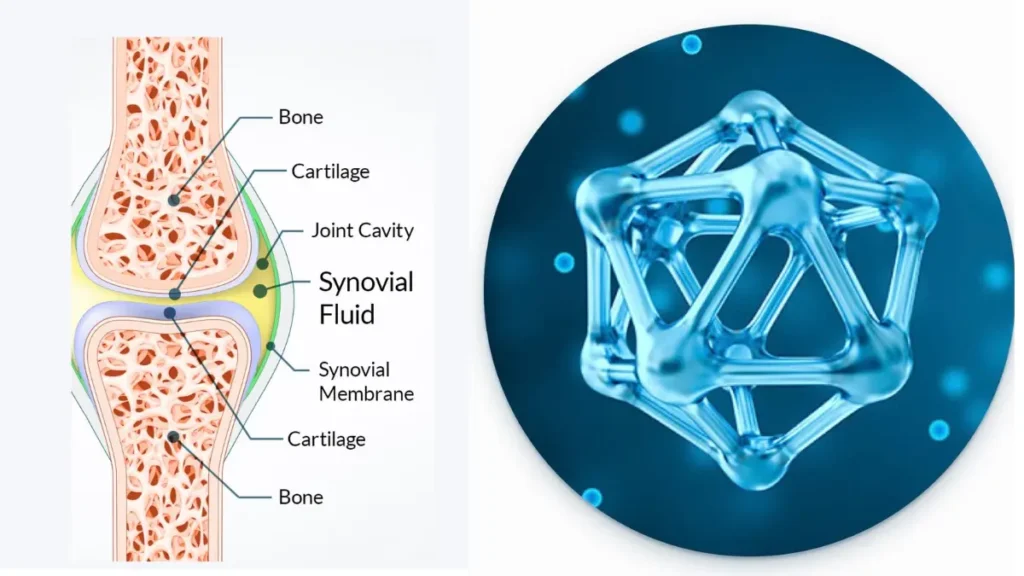
🟩 The underrated player: synovial fluid (your joint’s lubrication environment)
Synovial joints (like knees, hips, shoulders) contain synovial fluid — a viscous substance that helps:
- reduce friction between cartilage surfaces
- absorb shock
- transport nutrients to cartilage
- clear metabolic byproducts
Think of it like this: cartilage doesn’t have its own robust blood supply.
The synovial environment matters for how the joint guides.
Where hyaluronan (HA) fits
One key component of synovial fluid is hyaluronan (often called hyaluronic acid / HA) — a large molecule that helps give the fluid its viscosity and elastic “cushion” behavior. Research describes HA as central to the structure and function of joint fluid. (Fraser et al., 1997)
With aging (and with certain joint conditions), the quality of the synovial environment may change — and people often experience that as reduced “ease of motion.”
Important: that doesn’t mean “HA is magic.”
It means lubrication biology is real, and the joint environment is part of the mobility story.
🟩 The bigger pattern: stiffness → avoidance → weakness → more stiffness
Here’s the trap many people fall into:
Stiffness or discomfort → you move less → the system gets less capable → discomfort feels worse
This is why “just rest it forever” often backfires.
The body adapts to the signals you repeat.
The goal is not to punish your joints.
The goal is to restore confidence, load tolerance, and movement quality — gradually.
🟩 A simple 10-minute “mobility + lubrication” routine (practical, not heroic)
Do this 5 days a week for 2 weeks. Track how you feel.
Step 1 — 2 minutes: gentle joint cycling
Choose one:
- brisk walk in place
- slow step-ups on a low step
- stationary bike (easy)
Goal: warm tissues and “wake up” movement patterns.
Step 2 — 4 minutes: hips + knees
- Supported sit-to-stand (from a chair): 8 slow reps
- Hip hinge practice (hands on thighs): 8 slow reps
- Calf raises holding a wall: 10 reps
Step 3 — 3 minutes: spine + shoulders
- Wall slides: 8 reps
- Thoracic rotations (open book): 6 reps per side
Step 4 — 1 minute: breathe + downshift
Slow breathing (longer exhale) to reduce protective tension.
This isn’t a “workout.”
It’s a signal to your nervous system: movement is safe again.
🟩 Where a “synovial-support” supplement discussion usually enters (without hype)
Some people, after doing the basics (movement, strength, sleep), explore supportive options aimed at the joint environment, often with attention to ingredients linked to lubrication biology — including HA-related concepts.
That’s where Joint Genesis is often discussed in the market: as a supplement positioned around joint comfort and the synovial environment.
What matters here is how you think about it:
- not as a cure
- not as a shortcut
- but as a possible add-on to a real mobility plan
If you’re curious, use a simple standard:
Does the brand explain what it is, what it isn’t, and who should avoid it?
That’s usually where trustworthy choices separate from aggressive marketing.

🟩 — Go to the science pillar (Article 2)the “evidence-style” review
Want the full science-first breakdown of mobility, aging, pain cycles, and evidence-based strategies?
Read Article 2:→ Joint Genesis Review (Evidence-Based): Synovial Fluid, Hyaluronan (HA), and What’s Realistic After 40
🟩 When you should stop reading and get evaluated (red flags)
Seek urgent evaluation for:
- sudden severe pain after trauma
- inability to bear weight
- fever + hot swollen joint
- new weakness/numbness
- chest pain / shortness of breath
- loss of bowel/bladder control with back pain
Schedule a check if:
- symptoms persist beyond 2–3 weeks despite basic self-care
- morning stiffness lasts >1 hour
- progressive worsening, swelling, warmth, redness
🟩 Bottom line
If your joints feel “older” after 40, don’t panic — but don’t ignore it either.
Start with the repeatable basics:
- consistent movement
- strength support
- sleep and stress control
- and a smarter understanding of the joint environment (synovial fluid + HA)
Then, if you explore add-ons like Joint Genesis, treat them as supportive, not central.
Next step: go read→ Article 2 to get the full framework.
🛡️Medical Disclaimer
This article is for informational and educational purposes only. It does not provide medical advice, diagnosis, or treatment. Always consult a qualified healthcare professional for medical concerns.
🟩 Editorial Transparency
This is educational editorial content. Some pages in our content network may include affiliate links. If you purchase through those links, we may earn a commission at no extra cost to you.
🟩 Selected readings (real references, no invention)
- Fraser JR, Laurent TC, Laurent UB. Hyaluronan: its nature, distribution, functions and turnover. Journal of Internal Medicine. 1997;242(1):27–33.
- Jay GD, Waller KA. The biology of lubricin: near-frictionless joint motion. Matrix Biology. 2014;39:17–24.
- World Health Organization. Guidelines on physical activity and sedentary behaviour. 2020.
- American College of Sports Medicine. ACSM’s Guidelines for Exercise Testing and Prescription. (11th ed., 2021)
